
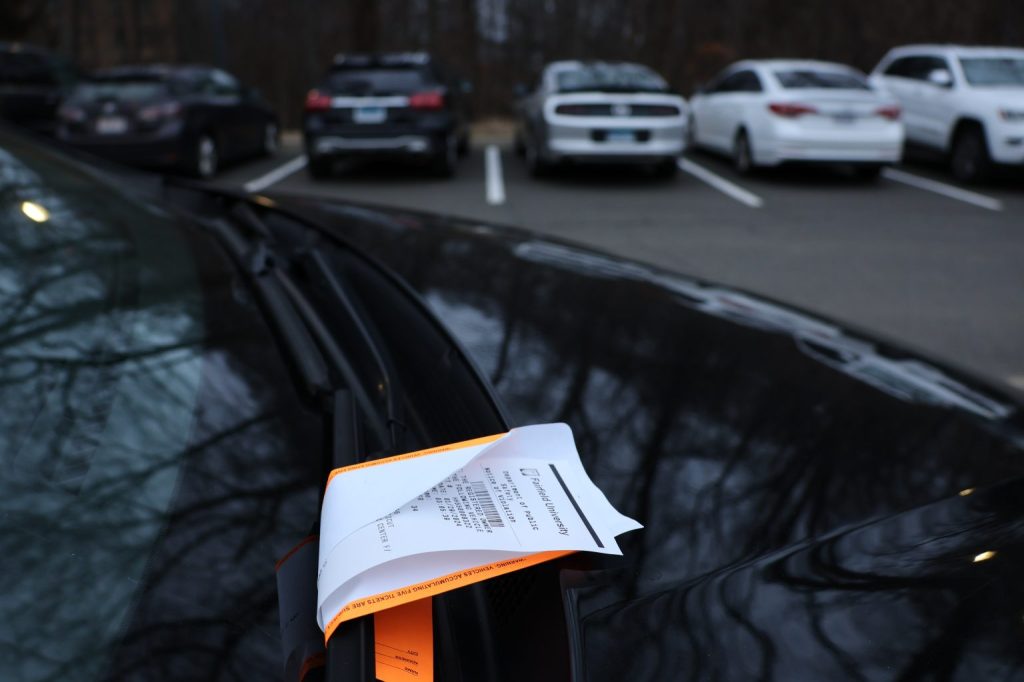
Fairfield University’s overcrowding problem remains a persistent issue for the undergraduate population, with recent concerns aimed at the limited parking capacity and the response from university officials.
This year, the administration has relied on private security personnel to dissuade residential students and faculty from using the parking garage located next to the Kelley Center, a building frequented by off-campus visitors. The garage is designated as the parking location for non-residential students and visitors.
While the move to close the main entrance to the garage in favor of a controlled access to the building was not announced to students, some took to Fizz to express their frustration over the unannounced change.
“Why is the parking garage blocked off?” one post from earlier last month reads.
But, as Fairfield’s rapid expansion continues, parking capacity has remained at a near-constant level, with no significant expansions expected. With no solution in sight, some students are taking matters into their own hands to bring attention to the issue that affects both junior and senior residential students with cars on campus.
Junior William Kent took to Fizz to express his frustrations over what he described as a “predatory parking ticket scam” and began collecting data from other students on the platform to better understand the current parking situation at Fairfield.
“I put out that form, like after the second parking ticket I got because it’s been multiple experiences of driving around campus for 25 minutes [and] not finding a spot,” Kent said in an interview with The Mirror.
He argued that the university’s limited parking capacity can lead students to unintentionally violate the parking rules. “It looked like double dipping,” he said, claiming that allowing non-permitted cars in residential lots leaves those with parking permits with no choice but to park illegally, resulting in more tickets and revenue for the university.
“It feels like an unfair practice from the University. It feels like I’m a pocket of money they can reach into; they don’t actually care about the situation,” Kent said. “It’s easier for them to cut it black and white and collect the ticket fees.”
Ticket fees have become another contentious issue this semester after DPS announced changes to its parking enforcement policies and citation fee structure, resulting in a $20 increase in parking ticket costs. Under the current structure, students with unregistered vehicles are fined $80 while those who park outside of student lots are subject to a $60 fine.
At the same time, the university is becoming increasingly strict with its booting and towing policy. Before, vehicles were booted after receiving five or more tickets, but now, DPS will boot cars with three or more tickets.
According to the University’s parking policies outlined on their website, first-year and sophomore residents without authorization to park on campus risk having their vehicles ticketed, booted or towed and subject to additional fines in addition to losing future parking privileges.
Residential students who have been authorized to have their vehicles on campus may risk having their cars booted or towed and having their case referred to the Dean of Students Office after their third parking violation.
The new, more aggressive policy comes as Connecticut enacts reforms to its towing laws aimed at providing stronger protections for vehicle owners. However, the law, which took effect earlier this month, exempts higher education institutions from offering those same protections.
September Ticketing Trends
During the first four weeks of the fall semester, the Fairfield Department of Public Safety logged over 100 enforcement runs for parking violations, according to the publicly available crime logs inspected by The Mirror.
While the department does not say how many tickets they issued over parking violations, the documents indicate that only six parking complaint calls were made in September and two incidents were referred to the student conduct for misuse of parking permits.
An analysis of the crime log entries covering Sept. 4 to Oct. 3 found that a third of the parking inspections by DPS officers occurred in two separate lots near the Quick Center and the Egan School of Nursing.
Lot O-1, a faculty and staff parking lot located between the Quick Center and Faber Hall, received at least 17 different visits from DPS officers, the most of any lot on campus. The Quick Center lot also accommodates residential parking, which became an issue last year and led to the department painting 8-inch circles in the residential spaces to distinguish them from faculty parking.
“These circles will clearly define where students can legally park in the Quick Center lot,” Public Safety said at the time in an email sent to students.
The second most-visited parking lot by DPS was K-3, which stands behind Mahoney Arena and the RecPlex. The lot is reserved for Fairfield faculty and staff.
Other faculty and staff lots frequently visited by DPS officers include the J-1 lot behind McAuliffe Hall, the O-2 lot in between the library, DSB and the back part of the Quick Center and the G-2 lot in Dolan Hall, which is used by Fairfield Prep. Campus security also had added interest in the Barnyard Manor parking lot, with six visits over the one-month period.
The Mirror reached out to the Department of Public Safety seeking a comment on the number of tickets issued for parking violations and the amount of revenue generated from the tickets. DPS and university officials did not provide an answer to The Mirror’s request.
The data also signaled that parking rules are consistently enforced throughout the weekday, with an average of 20 visits per day. During the first month of the semester, DPS logged 26 ticket detail trips, the most on a given day of the week.
Enforcement of parking rules decreased during the weekend, resulting in only four parking trips in September, likely due to the limited presence of faculty and staff on campus.
Most of the parking enforcement visits occur in the early hours of the morning, typically after midnight. Crime log data show that out of the 102 entries analyzed, 61 percent of the “ticket details” occurred between midnight and 5 a.m., suggesting that most enforcement occurs while students are asleep.
Twenty-three percent of DPS visits occurred between 5 a.m. and 10 a.m., with just 16 entries for the rest of the day.
 Julian Nazario