
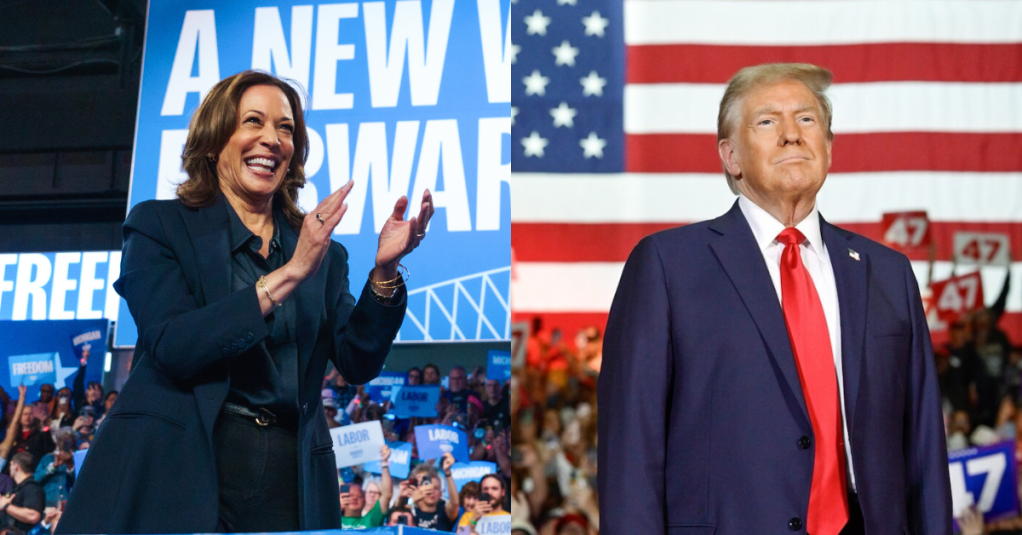
If the 2024 presidential election were being held today, most Fairfield University students would cast a vote for vice president Kamala Harris, a Mirror/Rearview survey shows.
The survey, conducted between Sept. 23 and Oct. 7 with a base of 488 Fairfield student respondents, showed that 45 percent of students would vote for Kamala Harris, while only 37 percent of respondents would vote for former president Donald Trump. At the time, only 14 percent said they were unsure who they were voting for.
Most undecided students, however, say they lean towards not voting at all in this election cycle.
Among those who said they were unsure about which candidate to support on Nov. 5, 36 percent said they were leaning towards not casting ballots; 14 percent said they were voting for someone other than Harris or Trump.
The survey results were also teased at an on-campus Open VISIONS Forum on Oct. 22, which featured The View’s cohost Alyssa Farah Griffin and political commentator Molly Jong-Fast.
When Professor Karla Barguiarena, the advisor for both student media publications, mentioned that four out of ten undecided student voters were thinking about not voting, the audience gasped.
In response to the survey findings, Griffin and Jong-Fast encouraged students to participate in the election, highlighting that the stakes are “fundamentally so high.”
“If you are feeling like ‘I don’t feel like I have a stake in this’, I don’t think it’s a bad idea to talk to people older than you in your life,” said Alyssa Farah Griffin, who served as the White House Director of Communication under former president Donald Trump. Griffin has since become an outspoken critic of Trump.
“For the college kids here, do you guys want to be able to get birth control bills?” said Jong-Fast as she commented on the recent Supreme Court decisions celebrated by Republicans and the possible effects of Project 2025.
Both women recognized that while the political atmosphere in the United States remains highly polarized, students should still participate in the election- even if it means keeping their choices to themselves.
The Mirror/Rearview survey marks the first time an on-campus media outlet has measured students’ opinions on the presidential election. It is part of both organizations’ efforts to cover the 2024 presidential election on campus.
While the results showed Harris winning over Trump, the survey also found that party identification was relatively equal on campus, with Republicans (33.3%) having a three-point advantage over Democrats (30.2%). Almost 32 percent of respondents identified as Independents.
When asked about the importance of who wins the election, more than half the respondents said it “really matters who wins” on Nov. 5.
THE ISSUES
As part of the survey, respondents were asked to select up to three issues they cared about the most: the economy, healthcare, abortion access, gun policy, the Supreme Court, foreign policy, immigration, climate change, racial inequality and crime. The issues were selected based on previous polling from the Pew Research Center.
The economy was selected by students as the main issue for this election cycle, followed by abortion access and immigration. However, when analyzed by who they were voting for, supporters of Harris selected abortion as the most critical issue, followed by the economy. Trump supporters said the economy and immigration were their two top issues.
Undecided voters, the group of students who said they did not know which candidate to support, also identified the economy as their top issue. However, a third of undecided student voters are leaning towards not voting in the election.
THE METHODOLOGY
To survey students, both organizations sent out emails to the student body asking them to participate in the election survey. The Office of Student Engagement also sent an email to students.
The unscientific survey included participation from undergraduate and graduate students from all classes.
Out of the students who shared their gender identity, 68.5 percent identified as female, while a third of the respondents reported being male. Three graduate students identified as non-binary or gender non-conforming.
In terms of class composition, four out of ten respondents identified as first-year students. Sophomore students accounted for 21 percent of respondents, while senior and junior students accounted for 17.8 percent and 14.3 percent, respectively. Almost seven percent of the respondents were graduate students.
 Julian Nazario